Seasonal Allergies Can Follow Your Child Into The Classroom
Seasonal allergies can make it harder for your child to concentrate, remember instructions and stay engaged at school. Congestion, itchy eyes and repeated sneezing are distracting on their own. If symptoms interrupt sleep, the resulting fatigue can make an ordinary school day feel even heavier.
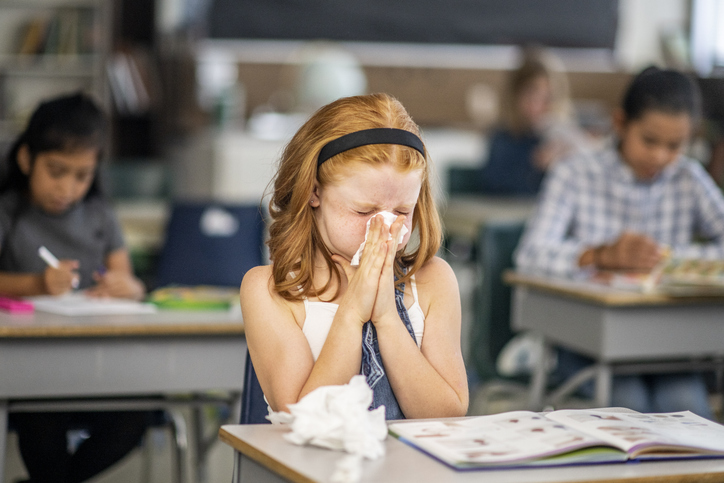
According to the Children’s Hospital of Philadelphia, seasonal allergies may contribute to fatigue and poor concentration at school when symptoms interfere with sleep.1 You might notice unfinished assignments, irritability or a child who seems unusually checked out. That does not necessarily mean motivation is the problem.
The specific pollen trigger can help explain when symptoms appear, but tree, grass and ragweed allergies do not usually produce reliably distinct symptom sets. Each can cause sneezing, nasal congestion, a clear runny nose, itchy or watery eyes, coughing and throat irritation. Timing often provides the stronger clue:
- Tree pollen is a common spring trigger, often affecting children during April and May.
- Grass pollen tends to become more prominent in late spring and summer, including June and July.
- Ragweed pollen commonly causes trouble from late summer into fall, just as many children return to school.
Your child’s individual reaction may still vary. One pollen may cause intense eye irritation while another seems to bring more congestion, but that pattern is personal rather than a dependable difference between allergens.
How Allergy Symptoms Can Disrupt Learning
A stuffy nose can make sleep restless. Itchy eyes can pull attention away from reading. Sneezing, coughing and frequent trips for tissues create small interruptions that add up across a school day.
Researchers studying children with troublesome grass pollen allergies found that the allergic group made more spatial working-memory errors than children without allergies during pollen season, though the study did not find significant differences across every measure of memory or attention.2 That distinction matters. Allergies do not affect every child or every cognitive skill in the same way, but they can create genuine barriers to learning.
For families across Greater Raleigh, the overlap between ragweed season and the start of school can make changes in attention especially easy to mistake for back-to-school stress. Look for patterns. Does your child struggle more after outdoor activities, sleep poorly on high-pollen days or improve when the season changes?
Can Seasonal Allergies Make A Child Forgetful At School?
Yes, allergy symptoms may interfere with working memory, particularly when a child is uncomfortable, fatigued or experiencing significant symptoms during pollen season. Your child may lose track of multistep directions or need more time to complete familiar work.
When Should A Parent Seek Help For A Child’s Allergies?
Talk with a healthcare professional when symptoms repeatedly disturb sleep, affect classroom focus or limit your child’s usual activities. An evaluation can help distinguish seasonal allergies from recurring infections and identify which allergens may be causing the pattern.
Start With A Conversation, Then Look At The Pattern
Ask your child what the school day feels like when allergies are active. Skip the general “Are you okay?” and try something more concrete: Is it hard to hear the teacher when you’re congested? Do your eyes bother you while reading? Are you tired before lunch?
A teacher may have noticed changes too. Comparing what happens at home, outdoors and in the classroom can give you a clearer picture of how much allergies are interfering.
You do not have to wait until grades drop. If known or suspected allergies are affecting sleep, concentration or participation, Raleigh Capitol Ear, Nose, Throat & Allergy can help your family understand the triggers and discuss appropriate treatment options. The goal is not to push your child through the season. It is to help them feel well enough to be present for it.
Sources
1 Children’s Hospital of Philadelphia. “Seasonal Allergies: Keeping Symptoms in Check.” https://www.chop.edu/news/health-tip/seasonal-allergies-keeping-symptoms-check
2 Pediatric Allergy and Immunology. “Cognitive Dysfunction and Quality of Life During Pollen Season in Children With Seasonal Allergic Rhinitis.” https://pmc.ncbi.nlm.nih.gov/articles/PMC7818136/